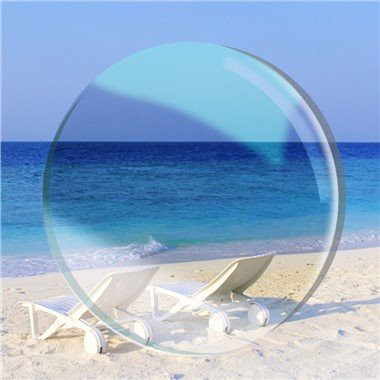
The main performance of the color changing lens
Jul 16, 2021
1. In the absence of ultraviolet light, the transmittance of the lens is relatively high. The discoloration of the color changing lens is mainly driven by the ultraviolet light in the environment. In an environment without ultraviolet light, the transmittance of visible light can reach more than 84%. Lenses can generally be used for vision correction, just like ordinary white lenses.
2. Under ultraviolet light or sunlight, the shading rate of the lens is at least 50%
In developed countries and regions such as Europe, America and Japan, the main varieties of color-changing lenses are gray and brown. The shading rate of most types of these two kinds of lenses can reach more than 50%, and the shading rate of the most common type is 70%. Under sunlight, color-changing lenses are used as sunglasses. Of course, there are also types with a shading rate of less than 50%, but due to the limited shading, it is of little use.
3. UV protection
A certain amount of UV absorber is added to the production process of the color-changing lens, so the lens itself has the function of UV protection, and the color-changing dye mainly changes color by absorbing ultraviolet rays. Therefore, the UV protection function of the color-changing lens is generally better. of. Generally, the internationally accepted gray and tea lenses can absorb more than 95% of ultraviolet rays below 380 nanometers, and can also achieve more than 85% of ultraviolet rays below 400 nanometers. In addition, at present, most photochromic lenses are treated with multi-layer vacuum coating and anti-electromagnetic wave treatment, which is the so-called EMI coating treatment. The color-changing lens treated in this way looks more transparent and has an isolation effect on electromagnetic waves emitted by various electrical appliances including computers.
4. Fast discoloration
The color change speed of the mature technology of the color changing lens is extremely fast. Generally, if the lens is placed in the sun for more than 1 minute, the light transmittance of the lens can be reduced to more than 80% of the maximum value. When the lens is turned indoors from the sun for 2 minutes, the light transmittance of the lens returns to more than 60%. The discoloration speed of the lens is faster than the speed at which the eyes adapt to light.
5. Long service life
The service life of a color-changing lens consists of two parts, one part is the service life of the lens material itself, this life requirement is the same as that of ordinary resin lenses; the life of the other part is determined by the life of the color change agent in the lens, and generally requires the effectiveness of the color change agent It must be longer than the life of the resin lens itself. The effectiveness of the so-called color changing agent refers to the reversible change of color changing and fading under the irradiation of ultraviolet rays. If the color changing agent does not change color, we say that the color changing agent has failed, and the life of the color changing lens will end at this time. NS. Generally speaking, the service life of the mature technology of the color changing lens can reach more than several years.
6. Sensitive to temperature
At present, all color-changing resin lenses are more sensitive to temperature, that is, when the temperature is high, the discoloration and discoloration of the lens are fast, and the depth of discoloration is shallow; when the temperature is low, the discoloration and fading speed of the lens are slow, and the depth of discoloration is deepened. . This is why the depth of discoloration of color-changing lenses in summer is not as deep as in winter. For the same pair of lenses, the depth of discoloration outdoors in winter is deep, and the fading speed when returning indoors is slow; in summer, the discoloration speed is much faster, but the depth of discoloration is not as deep as in winter. What needs to be explained here is that the depth of discoloration in summer is shallow, but the shielding rate of visible light decreases, but the blocking rate of ultraviolet rays does not decrease, so the protective effect is not reduced. In complete darkness, the color-changing lens may not fade to a colorless state, but the lens can quickly fade back when you see the natural light indoors. The phenomenon of shallow depth of discoloration of color-changing lenses under high-temperature climate conditions is common, and the current level of technology is not enough to completely solve this problem. However, there is still a big difference in this aspect between different quality color changing lenses.
7. The speed of discoloration is related to the hardness of the lens
The discoloration speed of the lens has a certain relationship with the hardness. Generally speaking, the hardness of the lens is high, and the discoloration speed is slow; the hardness of the lens is low, and the discoloration speed is fast. Fast discoloration of the lens should be a good thing, but if the material of the lens is too soft, it will affect the service life of the lens, because the too soft lens tends to have insufficient polymerization reaction, and it is prone to deformation after a long time.